
Most people preparing for IELTS General Training do it alone, between work and life. The hard part is rarely finding practice tests; it is knowing what to practise next, and whether it is working.
This article shows how an online IELTS General Training study plan can handle that: a goal band, your weakest areas, exam vocabulary organised by theme, and mock exams that show your trend.
In this article we'll cover:
- what is in the plan and how to start it
- how the goal band and weak areas steer your practice
- how reading, listening, writing and speaking are practised
- how the vocabulary themes and the word drill fit in
- how mock exams and estimated bands work, and what they cannot tell you
What IELTS General Training asks of you
IELTS General Training has four parts: Listening, Reading, Writing and Speaking. Listening and Speaking are the same as in the Academic version. Reading uses everyday and workplace texts, and Writing starts with a Task 1 letter and continues with a Task 2 essay. It is commonly taken for work, training or migration plans.
Each skill is marked on a band scale, and you also get an overall band. Preparing well means covering all four skills and not leaving one weak. Many people over-practise the skill they already like.
Start the plan
Open the practice page, choose English, and pick IELTS General Training on the exam card. You then choose:
- Your goal band. The band you need for your visa, job or course.
- Your test date (optional), so the pacing can follow it.
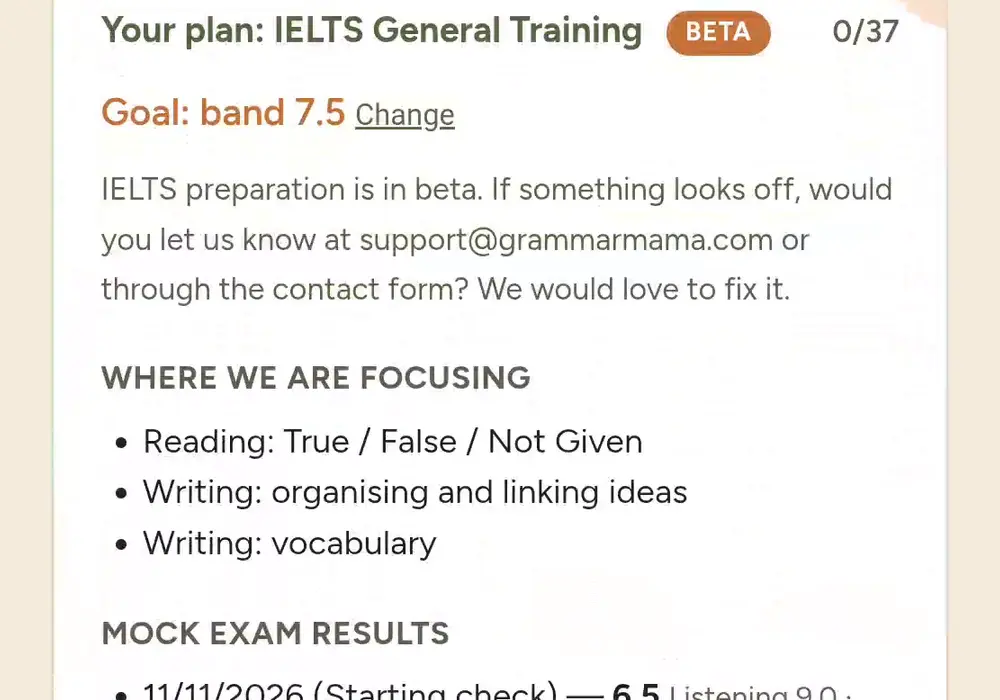
New accounts have a free trial, and during it you can start one IELTS plan. The plan is marked Beta: it is new, and your feedback helps. If something looks off, write to support@grammarmama.com.
Your goal band, and changing it
The goal band sits at the top of your plan. Tap Change next to it whenever your target moves, for example after a new requirement from a university or employer.
The goal shapes how demanding the reading and listening questions are and how the examiner role in speaking practice behaves. It is not a guarantee: it tells the plan how far you have to go.
Where we are focusing: your weakest areas
The plan keeps score of how you do in every part of the exam: reading question types, the writing criteria, speaking criteria. It lists the three weakest areas on your plan, for example Reading: True / False / Not Given, Writing: organising and linking ideas and Writing: vocabulary.
These are not decoration. The next exercises are picked to target them: a grammar point that supports linking ideas, a reading task of the question type you miss most, and so on. As your marks improve, the list changes.
Exam-style practice for each skill
Your next exercise is shown on the practice page, and it follows the plan, one skill at a time.
- Reading. A passage with typed questions: True / False / Not Given, matching headings, or filling gaps. You answer all questions together and get them marked, so you see where the mistakes are.
- Listening. A recorded conversation with a form to complete or multiple-choice questions. The transcript only appears once you are done, so you cannot read ahead.
- Writing. A Task 1 letter (about 150 words) or a Task 2 essay (about 250 words). It is marked against the four writing criteria, and the feedback names your credit points and what to fix.
- Speaking. An interview with an examiner who asks you the questions and does not correct you mid-answer, as in the real test. Part 2 has a preparation minute and a timed talk. Afterwards you get an assessment of fluency, vocabulary and grammar.
A note on pronunciation: a transcript of your speech has no sound, so the written assessment does not give a pronunciation band. Instead, the plan estimates it from how your spoken answers score in pronunciation practice across the app.
You can switch I can listen and I can talk off if you cannot use sound or a microphone right now; the plan then adapts the exercises.
Themes and the word drill
IELTS recycles everyday topics, so the plan keeps themes: work and careers, education and training, housing and neighbours, travel and transport, health, food, shopping, technology, environment, community, leisure, family, money, events, complaints and requests, opinions and arguments.
Each theme shows how many of its words you know and how many exercises you did. Tap Words I suggested to open the theme's vocabulary. A theme counts as ready when you use most of its words correctly twice, and have done a few exercises on it. The plan then works on whichever theme you are furthest from.
The word drill on the practice page uses this week's exam words, so your pronunciation practice builds the same vocabulary you need in the writing and speaking tasks. Words from the plan stay separate from the ones you save yourself, and a finished plan lets them go again.
The same page also lists grammar topics the exam criteria reward, such as present perfect versus past simple, formal and informal tone in a letter, or covering every bullet point of a Task 1 letter, with the ones you are practising marked.
Mock exams and estimated bands
Practice is only useful if you can see progress. The plan gives you three kinds of check:
- A starting check (from B1 level, once per plan): a short test with one task per skill that gives your first estimated bands and seeds the weak-area list.
- A short mock exam: one listening, reading, writing and speaking task, about 40 minutes.
- A full-length mock: every task type of each skill, about 2 hours 45 minutes, as in the real test. Take it a section at a time, over up to a week.
Starting a mock asks first, with the duration and a reminder to find a quiet place. The result shows a band for each skill, an overall band only when all four skills were done, and the last results as a trend.
These bands are estimates. Listening and reading raw scores are converted with an approximate table, and writing and speaking use the mean of the marking criteria. Use them to see direction, not as a prediction. Mock exams are part of the Learner plan, which includes one each month; the pricing page has the current details.
A weekly routine that works
- Open the plan and read the three weakest areas.
- Do the next exercise; it already targets them.
- Do the word drill, a few minutes a day.
- Check your themes once a week.
- Every two to three weeks, a short mock. A full-length mock when your test is a month or so away.
How it compares
| Free practice tests | A tutor or course | GrammarMama plan | |
|---|---|---|---|
| Exam-style tasks | Yes, often only reading and listening | Yes | All four skills |
| Tells you what to practise next | No | Yes | Yes, from your weakest areas |
| Marked writing and speaking | Rarely | Yes | Yes, against the criteria |
| Vocabulary by exam theme | Sometimes | Sometimes | Yes, with progress per theme |
| Estimated band trend | Raw scores | From the tutor | Estimates from mock exams |
| Cost | Free | Highest | Trial, then a paid plan |
If you want a person to explain things, a tutor is the right choice. Many learners use a plan like this for daily practice and a tutor or course for questions.
How to start
- Open the practice page and choose English.
- Pick IELTS General Training on the exam card, set your goal band and, if you have one, your test date.
- Take the starting check, then follow the next exercise.
Key takeaways
- A good IELTS General Training study plan covers all four skills and keeps checking where you are weakest.
- Set your goal band and change it any time; the plan lists the three weakest areas and targets them.
- Reading, listening, writing and speaking come as exam-style tasks, marked in code or against the criteria.
- Themes and the word drill build the vocabulary the writing and speaking tasks need.
- Mock exams give estimated bands, not real scores. Use them for the trend.
- GrammarMama is independent of the IELTS test owners.
