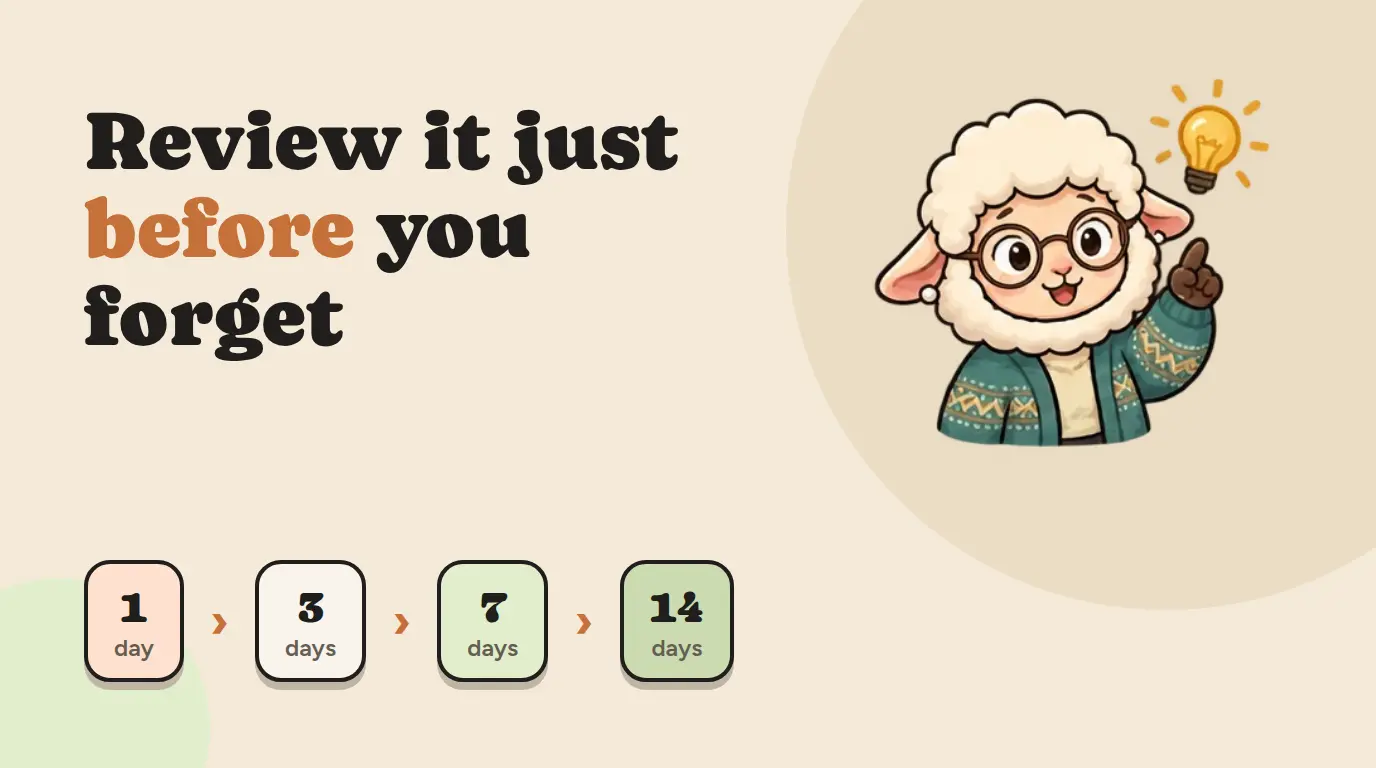
You learn a word on Monday, feel sure about it, and on Friday it is gone. That is not a bad memory, it is how memory works. Spaced repetition is the tested way to work with that, not against it: you review each word just as you are about to forget it, and every successful review pushes the next one further away.
In this article we'll cover:
- what spaced repetition is and why it works
- what the research on language learning actually found
- which intervals to use
- how to apply it without making flashcards by hand
Want to try it?

What is spaced repetition?
Spaced repetition is a review schedule with growing gaps. A new word comes back the next day, then after a few days, then after a week or two. If you remember it, the gap grows. If you forget it, the gap shrinks again.
The idea goes back to Hermann Ebbinghaus, who measured in the 1880s how quickly memories fade, and noticed that repeating something at spaced moments works better than repeating it in one block. Cramming feels productive because the word is fresh in your head. Spacing feels harder, because you have to pull the word out of memory, and that effort is exactly what makes the memory stronger.
What the research found
The spacing effect is one of the most replicated results in memory research
Cepeda and colleagues (2006, Psychological Bulletin) combined 839 assessments from 317 experiments. Spaced practice beat massed practice again and again. They also found that the best gap between two reviews depends on how long you want to remember: the longer the target, the longer the best gap.
It works in second-language learning too
Kim and Webb (2022, Language Learning) gathered the experiments on spacing in second-language learning: 48 experiments, 3,411 learners. Their findings:
- Spaced practice beat massed practice with a medium effect on tests right after learning (g = 0.58).
- On tests given later, the effect was medium to large (g = 0.80). The benefit grows with time.
- Longer gaps did better than shorter ones on delayed tests.
- Equal gaps and growing ("expanding") gaps worked about the same, so you do not have to find a perfect schedule.
What does g mean? It is Hedges' g, a standard measure of effect size: how far apart the spaced and the massed group are, counted in standard deviations. By common convention, about 0.2 is a small effect, 0.5 a medium one and 0.8 a large one. So g = 0.58 means that the average learner who spaced their practice scored about 0.6 standard deviations higher than the average learner who crammed.
Spacing also saves time
Kang (2016) reviewed the evidence for classroom use and argues that spaced review improves learning without extra time or money. You do not study more, you study the same minutes in a smarter order.
What the research does not say
Honest limits help you plan:
- Most second-language studies test vocabulary learned from flashcard-style pairs. The evidence for grammar rules, listening or free speaking is thinner.
- One recent study found that spacing helped explicit vocabulary knowledge (can you recall the word on a test) but showed no clear difference for implicit knowledge (using it automatically while reading or speaking). Reviews get a word into memory; using it in real sentences makes it fast.
- No study tells you the one perfect interval for everyone.
Which intervals should you use?
Given the evidence, a simple growing schedule is enough. A common one, and the one GrammarMama uses:
| Review | When |
|---|---|
| 1st | the next day |
| 2nd | 3 days later |
| 3rd | 7 days later |
| 4th | 14 days later |
Rules of thumb that match the research:
- Wait until it is hard, but not impossible. If a word is easy to recall, it is not time to review it yet.
- A miss resets the word, with a short gap again. That is normal and useful.
- Longer gaps for longer goals. If you want to remember a word for years, the later reviews should be weeks apart.
- Do reviews every day, in short sessions. Ten minutes daily beats one hour on Sunday.
The real problem: making the cards and keeping up
Most people who try spaced repetition quit for two reasons. Making the cards by hand takes longer than learning them. And reviews pile up: each word comes back about four times, so 20 new words a day means a huge daily queue within weeks.
Two habits fix this:
- Add fewer words than you think. About 5 new words a day is a pace you can keep. If many reviews are waiting, learn fewer new words, not more.
- Let the app write the cards. Pick words from texts you really read, and let the translation and example sentences be prepared for you. See a flashcards app that makes the cards for you.
How GrammarMama applies it
GrammarMama's Speak practice schedules every word for you:
- Each word returns after 1, 3, 7 and 14 days. Four successful reviews and it counts as mastered.
- Mastered words get check-ups much later, so they stay.
- A miss starts the word again with a short gap.
- You choose the pace. The app lowers the number of new words when many reviews are due, and offers a catch-up when you return after a break.
- Every review is spoken. You recall the word, then say it inside a sentence, and your pronunciation is scored. Speaking is its own memory aid: see why saying words aloud helps you remember them.
Other tools apply the same idea. Anki is more customisable and works offline; paper boxes (the Leitner system) work too. The schedule matters more than the tool.
How to start today
- Pick one language and a small daily goal, for example 5 new words.
- Add words from something you really read or heard, not from a random list.
- Review every day, even for five minutes, and keep the gaps growing.
- Use the words in sentences, spoken aloud, so they become automatic.
Get the Android app or open the vocabulary page in your browser. You can start for free; free accounts have a daily limit, which paid plans raise (see pricing).
Key takeaways
- Spaced repetition means reviewing each word at growing gaps, just before you forget it.
- A meta-analysis of 48 second-language experiments found spacing clearly beats cramming, and the gap widens on later tests (g = 0.58 immediately, g = 0.80 later).
- Longer gaps work better than short ones; equal and expanding schedules perform about the same, so 1, 3, 7, 14 days is a good, simple rule.
- The evidence is strongest for vocabulary; combine reviews with real speaking and reading.
- Keep the load small: about 5 new words a day, and let an app write the cards.
Want to try it?
References
- Cepeda, N. J., Pashler, H., Vul, E., Wixted, J. T., & Rohrer, D. (2006). Distributed practice in verbal recall tasks: A review and quantitative synthesis. Psychological Bulletin, 132(3), 354–380. 10.1037/0033-2909.132.3.354
- Kim, S. K., & Webb, S. (2022). The effects of spaced practice on second language learning: A meta-analysis. Language Learning, 72(1), 269–319. 10.1111/lang.12479
- Kang, S. H. K. (2016). Spaced repetition promotes efficient and effective learning: Policy implications for instruction. Policy Insights from the Behavioral and Brain Sciences, 3(1), 12–19. 10.1177/2372732215624708
- Nakata, T., & Elgort, I. (2021). Effects of spacing on contextual vocabulary learning: Spacing facilitates the acquisition of explicit, but not tacit, vocabulary knowledge. Second Language Research, 37(2), 233–260. 10.1177/0267658320927764
- Zheng, G., Nakata, T., Clenton, J., & Boutorwick, T. J. (2026). Effects of spacing on the acquisition of explicit and implicit vocabulary knowledge: An approximate replication of Nakata and Elgort (2021). Studies in Second Language Learning and Teaching, 16(2), 363–393. 10.14746/ssllt.49487
- Ebbinghaus, H. (1885). Über das Gedächtnis: Untersuchungen zur experimentellen Psychologie. Duncker & Humblot.
