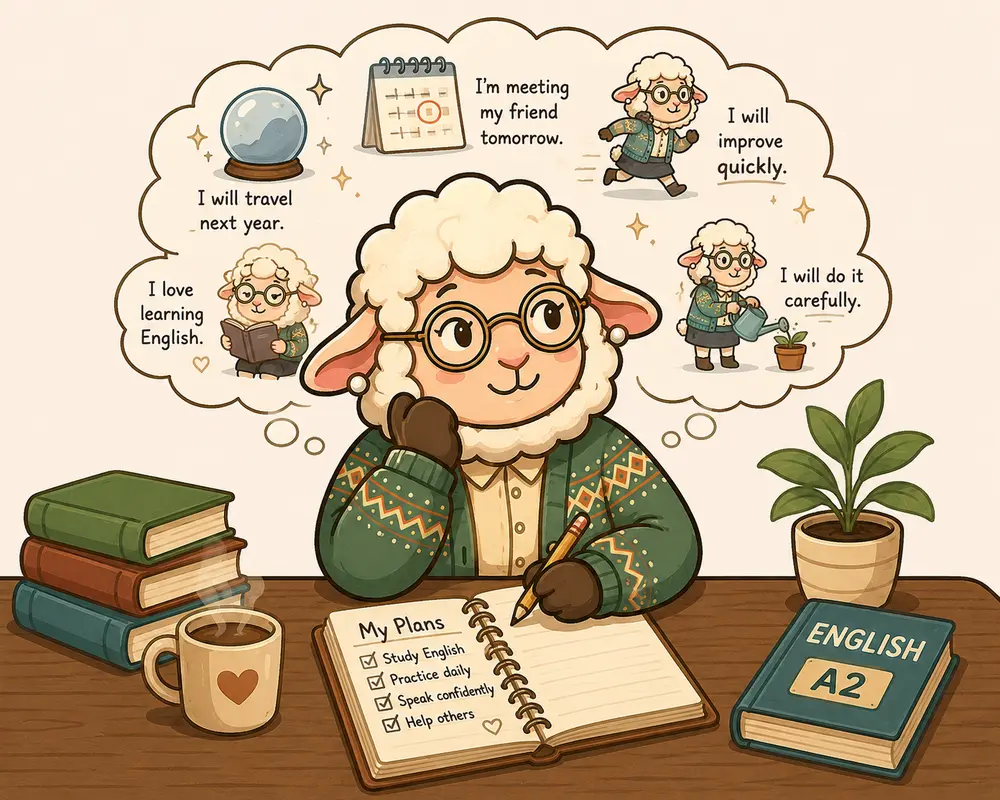
Last time we added four A2 lessons on pronouns, amounts, and plans — including be going to, your first step into the future.
This time we go further. Two more ways to talk about what's coming, plus two small building blocks you'll use in almost every sentence: how you do things, and what you love doing.
🆕 Four New A2 Lessons
We've added four new lessons to the A2 level, in three everyday families:
- Two more futures — I'll help you, I'm meeting Sam at six.
- How you do things — quickly, carefully, well.
- What you love doing — I enjoy reading.
👉 You'll find them all on the English A2 learning path.
🔮 Two More Ways to Talk About the Future
You already have be going to for plans. These two lessons add the other everyday futures, and each one has its own job.
The first is will — often called the future simple. You reach for it when you decide as you speak, and for predictions based on what you think: "It's cold." — "I'll close the window.", I think it'll rain.
👉 Will (predictions & instant decisions) covers will + base verb, the 'll and won't short forms, questions and negatives, and the helpful contrast with be going to — I'll buy some (decided now) vs I'm going to buy some (already planned). Watch the verb: ✅ She'll come, never ❌ She'll comes.
The second is the present continuous — the same am / is / are + -ing you use for now, but pointing at a fixed arrangement in the future: I'm meeting Sam at six.
👉 Present continuous for future arrangements shows when I'm seeing the doctor on Friday means the future, how a time word makes it clear, and how it sits next to be going to — both are fine for arrangements, with no new form to learn.
🏃 How You Do Things
Once you can say what happens, the next question is how. Adverbs of manner answer it: not just she sings, but she sings beautifully.
Most are just the adjective + -ly (slow → slowly, careful → carefully), with a few spelling changes (happy → happily) and a handful of irregulars — the most important being good, whose adverb is well.
👉 Adverbs of manner sorts out the -ly spellings, the irregulars (fast, hard, well), where the adverb goes, and the slip almost everyone makes — ❌ She sings good → ✅ She sings well. It also untangles the hard / hardly and late / lately traps.
❤️ What You Love Doing
How do you say you love films but can't stand traffic? After verbs of liking and disliking — like, love, hate, enjoy, don't mind, prefer — English uses the -ing form.
I love cooking. She enjoys swimming. They don't mind waiting. The pattern is the same every time, and it's one of the easiest ways to sound natural about your free time.
👉 Verbs + -ing lists the verbs that take -ing, the spelling rules (swim → swimming, make → making), and the most common mistake of all — ❌ I enjoy to read → ✅ I enjoy reading.
🆓 Still Free, Still Open
Like everything in the curriculum, all four lessons are free to read — no account, no login, no paywall. Each one ends with a short quick-check so you can test yourself on the spot.
Bookmark them, share them, come back whenever a will / going to or good / well moment trips you up.
⭐ Take a Look
The curriculum keeps growing, one lesson at a time.
👉 Open the English A2 learning path, pick the lesson you need today, and take the next confident step in your English.