Last time we moved into tense territory — past tenses and polite requests: the past continuous, the present perfect with ever/never and for/since, and can/could/may for asking politely.
This time the four new lessons are about building more precise, more fluent English: choosing the right word in front of a noun, describing a path, adding a mini-clause that says who or what something is, and knowing when something is too much or just enough.
🆕 Four New A2 Lessons
We've added four new lessons to the A2 level:
- The right article — I saw a cat. The cat was black.
- Where you're going — She walked into the room. We drove through the tunnel.
- Which one exactly — the teacher who helped me, the film that we watched
- More than needed vs. just right — It's too cold. It's warm enough to go out.
👉 You'll find them all on the English A2 learning path.
📌 Which Word in Front of the Noun: Articles
A or an? The? Nothing at all? English has three article choices — the indefinite article (a / an), the definite article (the), and the zero article (no article). Each has a clear job.
A / an introduces a singular countable noun for the first time, or means "any one of this kind": She's a teacher. I need a pen. The choice between a and an depends on the sound (not the spelling) of the next word — a before a consonant sound, an before a vowel sound: a dog, an apple, a university (/juː/ starts with a y sound), an hour (the h is silent).
The is for something you and the listener both know: the second mention of something, a unique thing (the sun), or when the context makes it clear (Can you close the window? — the one in this room). Zero article goes with plural or uncountable nouns in general (Dogs are loyal. Water is essential.) and most proper names (I live in Paris).
👉 Articles: a / an, the, zero article covers all three choices with clear rules, the a vs. an sound rule, fixed phrases that take no article (at work, by bus, go to school), and the most common traps — ❌ I am teacher → ✅ I am a teacher, ❌ He lives in the France → ✅ He lives in France.
🚶 Where You're Going: Prepositions of Movement
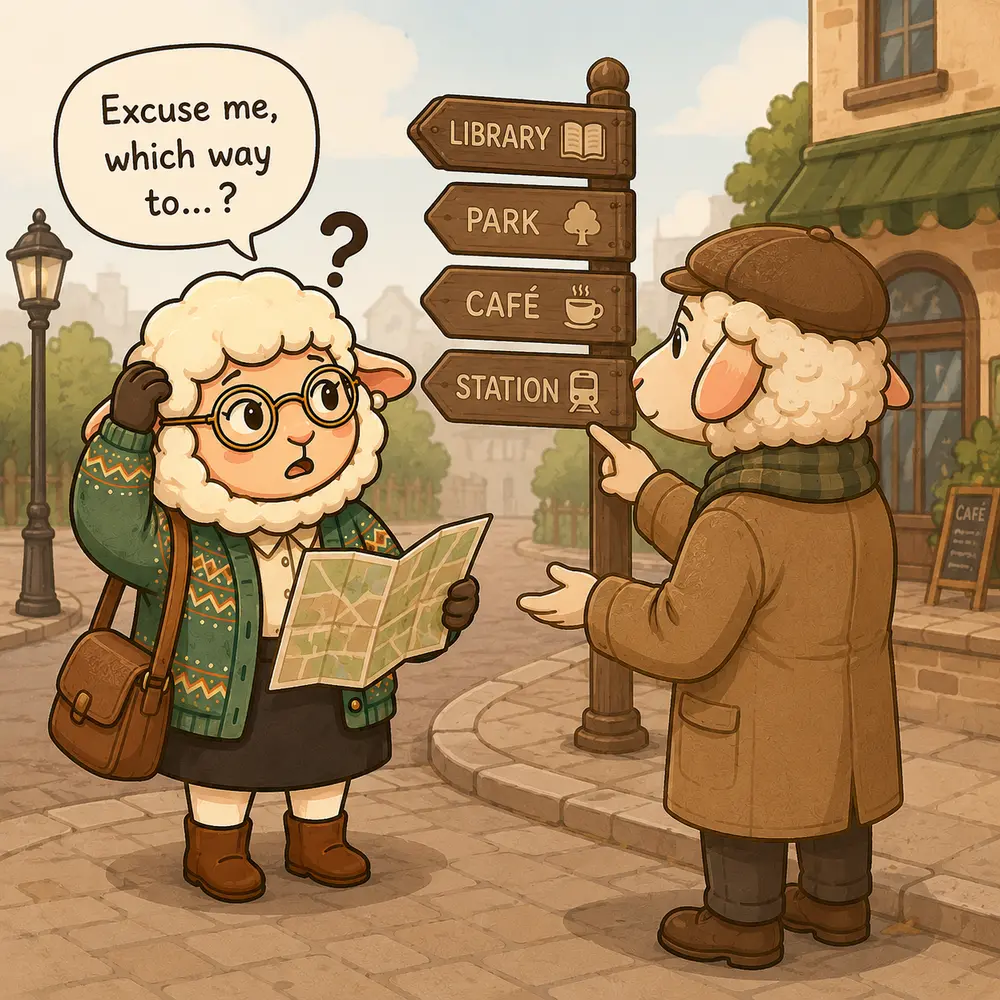
When you describe a path — where someone starts, where they're heading, how they get past an obstacle — English uses prepositions of movement. Most of them paint a clear visual picture of the route.
From gives the starting point; to gives the destination (We travelled from London to Paris). Towards means heading in a direction without necessarily arriving. Into / out of cross a boundary — entering or leaving an enclosed space (She walked into the room. He ran out of the building.). Onto / off do the same for surfaces (The cat jumped onto the table. She fell off the bike.).
Across goes from one side to the other of a surface (We swam across the river); through passes inside something enclosed or dense (We drove through the tunnel.). Along follows a length, past goes beyond a fixed point, and over / under describe movement above or below something.
👉 Prepositions of movement groups them by meaning, covers the most useful contrasts — across vs. through, to vs. towards, into vs. in — and the slips to avoid: ❌ We drove through the bridge → ✅ We drove across the bridge.
🔗 Who and What: Basic Relative Clauses
Instead of two short sentences, a relative clause lets you add information about a noun in one smooth flow:
The woman lives next door. She teaches music. → The woman who lives next door teaches music.
The pronoun is simple: who for people, which for things, and that for either. The clause goes immediately after the noun it describes. When the pronoun is the subject of its clause (nothing else does the action), keep it — the colleague who helped me. When it's the object (there's already another subject after it), you can drop it entirely — the film I recommended = the film that I recommended.
👉 Basic relative clauses (who, which, that) covers the subject–object distinction, when you can leave the pronoun out, where for places (the café where we met), and the most common mistakes — ❌ She is the doctor which treated me → ✅ ...the doctor who treated me, ❌ The man who he lives next door → ✅ The man who lives next door.
⚖️ More Than Needed vs. Just Right: Too / Enough
Too and enough both talk about degree, but they pull in opposite directions. Too means "more than is good or possible" — always a problem: The coffee is too hot (I can't drink it). Enough means sufficient: The coffee is cool enough to drink.
The word order is the key: too goes before adjectives and adverbs (too cold, too fast); enough goes after adjectives and adverbs but before nouns (warm enough, enough time). Both naturally lead into a to + verb phrase: too hot to drink, warm enough to swim in.
For nouns, the pairing is too much (uncountable) or too many (countable): too much traffic, too many people. And very is not the same as too — very is neutral, too signals a problem.
👉 Too / enough covers too, too much, too many, enough before nouns, enough after adjectives and adverbs, and the too / enough + to-infinitive structure — with common mistakes: ❌ She is enough old to drive → ✅ She is old enough to drive, ❌ The bag is very heavy to carry → ✅ The bag is too heavy to carry.
🆓 Still Free, Still Open
Like everything in the curriculum, all four lessons are free to read — no account, no login, no paywall. Each one ends with a short quick-check so you can test yourself on the spot.
Bookmark them, share them, come back whenever an article choice or a too / enough sentence trips you up.
⭐ Take a Look
The curriculum keeps growing, one lesson at a time.
👉 Open the English A2 learning path, pick the lesson you need today, and take the next confident step in your English.