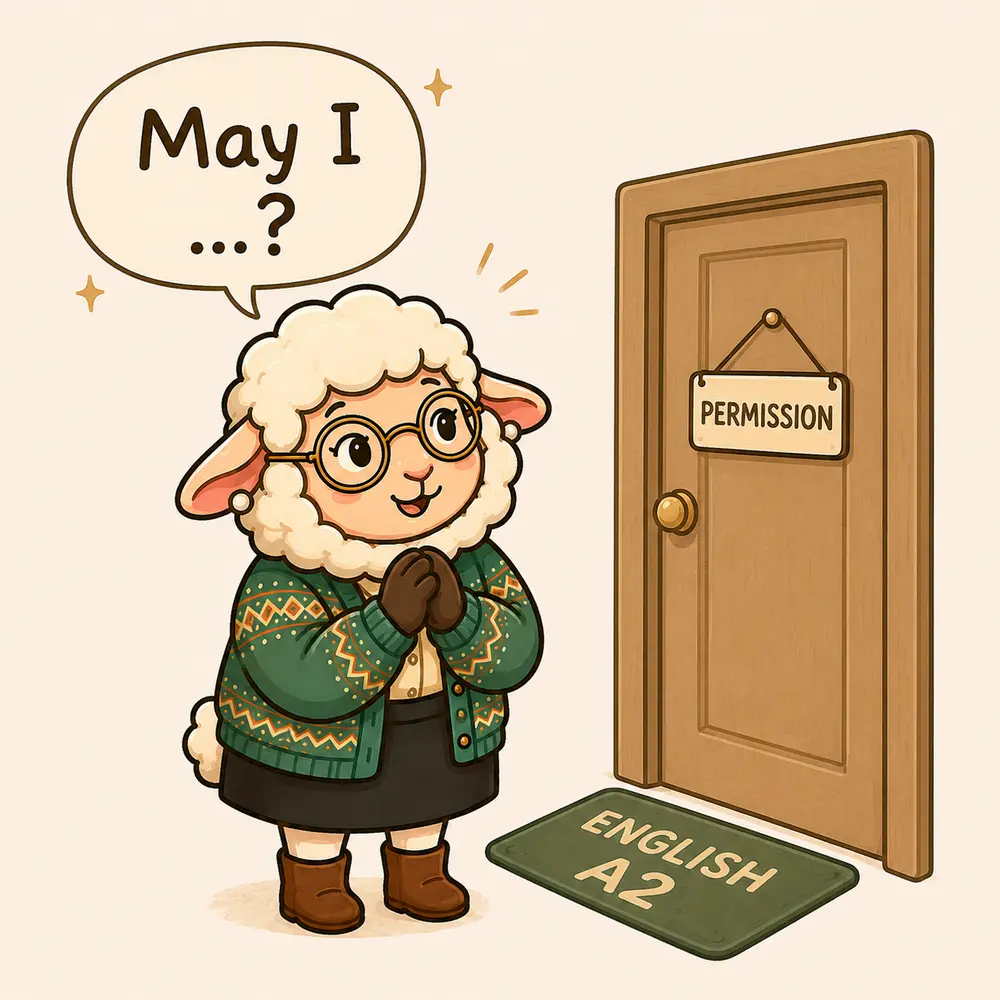
Last time we added four A2 lessons on obligation, advice, and ability — have to and must for necessity, should for advice, be able to for ability, and the infinitive of purpose.
This time we move into tense territory and social English: what was happening at a past moment, what has happened in your life, how long something has been going on — and the modal verbs that let you ask for all of it politely.
🆕 Four New A2 Lessons
We've added four new lessons to the A2 level, in four everyday areas:
- Past in progress — I was cooking when the phone rang.
- Life experiences — Have you ever been to Japan?
- Unfinished situations — I've lived here for five years.
- Polite requests — Could you help me? May I come in?
👉 You'll find them all on the English A2 learning path.
🎬 An Action in Progress: Past Continuous
When you want to describe what was happening at a particular moment in the past — not that something happened, but that it was already under way — English uses the past continuous: was or were plus the -ing form. At nine o'clock she was studying. They were sleeping when I arrived.
The most common use is the interrupted action: a longer background event (past continuous) was in progress when a shorter event (past simple) cut across it. I was cooking dinner when the phone rang. The past continuous paints the scene; the past simple marks the moment. You can also use it for two actions running in parallel: While she was studying, he was cooking.
👉 Past continuous covers the full form (was for I/he/she/it, were for you/we/they), spelling the -ing form, the interrupted-action pattern with when and the parallel pattern with while, negatives and questions, state verbs that stay in the past simple (I knew, never I was knowing), and the slips to avoid — ❌ I was cook dinner → ✅ I was cooking dinner.
🌍 Life Experiences: Present Perfect with Ever and Never
When you want to talk about things you have or haven't done at some point in your life — without saying exactly when — English uses the present perfect: have or has plus the past participle. The time isn't the point; what matters is whether it happened at all. Have you ever eaten octopus? I've been to Italy three times. She's never flown in a plane.
Two things to get right: ever belongs in questions (Have you ever tried sushi?), and never is already negative, so don't add not — ❌ I haven't never tried it → ✅ I've never tried it. And for travel: been to means went and came back (an experience), while gone to means the person is still out — for life experiences, you almost always want been, not gone.
👉 Present perfect: ever / never (experience) covers how to form the past participle (regular -ed vs irregular been / seen / eaten), how to use ever in questions and never in statements, the been vs gone distinction, and when a finished past time (yesterday, last year) switches you to the past simple instead — ❌ I've seen him yesterday → ✅ I saw him yesterday.
⏳ How Long It Has Lasted: Present Perfect with For and Since
The same present perfect — have / has + past participle — has a second key use at A2: a situation that started in the past and is still true now. The time expressions here are for and since. I've lived here for five years. She's known him since 2019. Both sentences anchor the present to a starting point in the past.
The rule is clean: for + a length of time (for two years, for ages); since + a starting point (since Monday, since I was a child). The biggest trap is reaching for the present simple because the situation feels current: ❌ I live here for five years → ✅ I've lived here for five years — only the present perfect reaches back to when it started.
👉 Present perfect: for & since shows the for vs since distinction, how to ask How long…? questions, the verbs you'll see most (be, have, know, live, work), and the classic mistakes — ❌ since two years → ✅ for two years, ❌ for last April → ✅ since last April.
💬 Asking Politely: Requests and Permission
To ask someone to do something for you, or to ask whether you're allowed to do something yourself, English uses three small modal verbs: can, could, and may. They never change form, and the verb after them is always the plain base form — no to, no -s, no -ed: Can you help me? Could I borrow your pen?
The choice comes down to register: can is friendly and direct (fine with friends and in everyday situations), could is a little softer and safe almost anywhere, and may is the most formal (official or service settings). For asking someone else to act, use Can / Could you. For asking permission yourself, use Can / Could / May I. When answering a Could I…? question, reply with can, not could — ✅ Yes, you can, never ❌ Yes, you could.
👉 Requests and permission (can, could, may) covers both situations (asking others to act vs asking permission for yourself), the politeness scale, how to answer each type, and the slips to avoid — ❌ Could you to help me? → ✅ Could you help me?, ❌ May you open the door? → ✅ Could you open the door?
🆓 Still Free, Still Open
Like everything in the curriculum, all four lessons are free to read — no account, no login, no paywall. Each one ends with a short quick-check so you can test yourself on the spot.
Bookmark them, share them, come back whenever a was / were or for / since moment trips you up.
⭐ Take a Look
The curriculum keeps growing, one lesson at a time.
👉 Open the English A2 learning path, pick the lesson you need today, and take the next confident step in your English.